 |
TEDBURY CAMP QUARRYA geological gem inthe Mendip Hills |
General description
Tedbury Camp Quarry takes its name from the Iron Age fortification that partially encircles the high ground 500m southwest of the quarry. Flanked by deeply incised valleys containing the River Mells (to the north) and Fordbury Water (to the south), the area provided a natural site for one of the many hill forts that are known on the Mendip Hills. Remnants of the bank and ditch fortification that stretches between the two valleys can still be traced through the wooded hilltop (Figure 2).
Intermittent quarrying activity during the 20th century removed much of the Carboniferous limestone that forms the narrow promontory at the confluence of the River Mells and Fordbury Water. When the quarry was operational, the processing plant was located on the natural, near-horizontal surface of Carboniferous limestone that was revealed after the thin (4-6m) overburden of Jurassic limestone was removed. In the 1960s, quarrying ceased and the flat bench was used for storing hardcore and rubble.
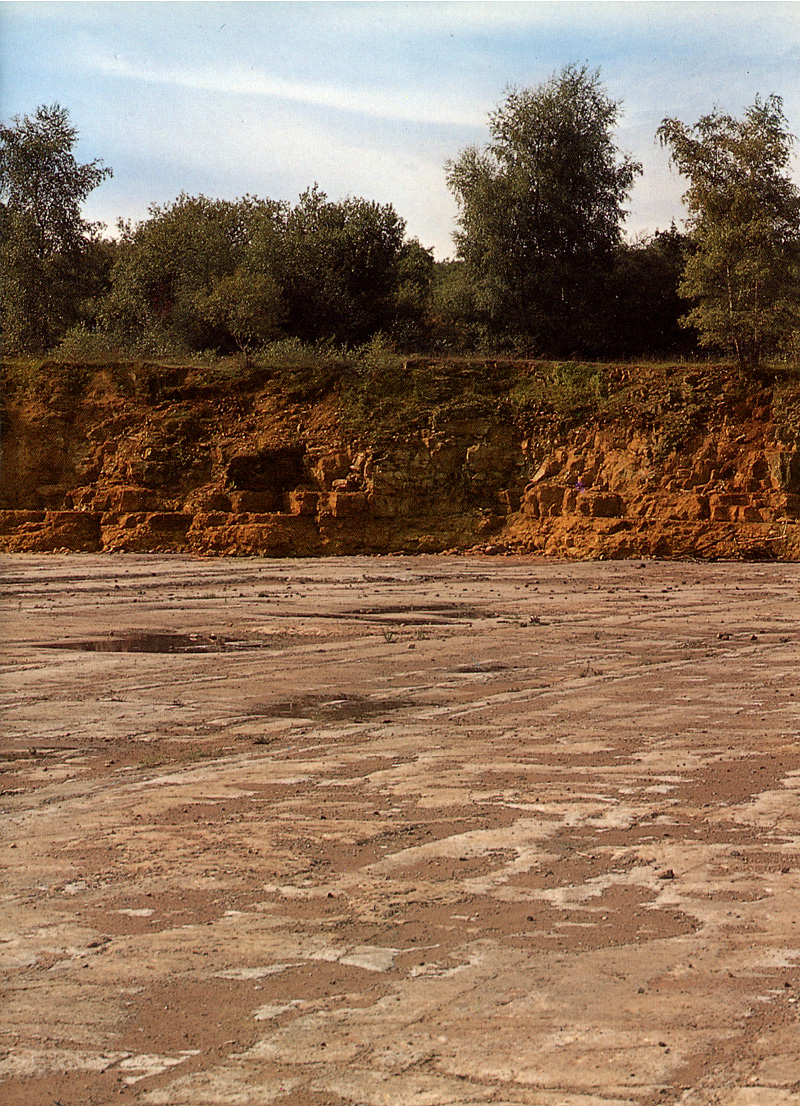
Early in the 1980s, geologists were carrying out field surveys in eastern Mendip to identify sites for inclusion in a geological guidebook (Duff et al., 1985), and the educational potential of this partially obscured exposure was championed principally by Charles Copp, then a postgraduate researcher at Keele University. Negotiations with the quarry owner resulted in the former Nature Conservancy Council being permitted to clear the site, revealing a spectacular expanse of some 4,300m2 of Carboniferous limestone overlain by low cliffs of Jurassic limestone (Figure 3)
|
Figure 3. Tedbury Camp Quarry when first cleared by the Nature Conservancy Council Reproduced from Duff et al., 1985. |
Although the site has no statutory protection, it has been conserved on a voluntary basis for the last two decades and the principal threats to its existence come from invasive silver birch, buddleia and fly tipping (Whiteley, 2006). It was identified as a Regionally Important Geological Site (RIGS) and included in the RIGS register held by Somerset Environmental Records Centre in 1987. In 1993 it was recognised as a County Geology Site and incorporated within the Mendip District Plan. More recently, Tedbury Camp has been included in Somerset Geology – A Good Rock Guide, used as an exemplar in the assessment of geodiversity at geological sites nationwide (Scott et al., 2007), and featured in Farrant’s (2008) compilation of geological localities in eastern Mendip.
This site is large and the Jurassic exposures can be replenished, so judicious hammering and collecting is permitted, although care should be taken to avoid damaging the unconformity surface. That said, a stiff-bristled brush and a good hand lens are better tools for revealing the detail that makes Tedbury Camp so interesting.
